Phishing Emails in Malaysia: Why Every Organisation Needs the Right Tools, Training, and Culture
Primary Guard · July 5, 2026 · 8 min read
Phishing represents 68% of all cyber fraud in Malaysia. Learn how IT managers and sysadmins can fight back with DMARC, email security, IAM, EDR, and continuous staff training through phishing simulations.
The Inbox Is Now the Front Line
It starts with one email. An employee in your finance team receives a message that looks exactly like it came from your CEO. The subject line reads: "Urgent — Supplier Payment Authorisation Needed." The logo matches. The tone is right. The urgency feels real. Within minutes, a transfer is authorised — and your organisation just lost hundreds of thousands of ringgit to a phishing attack.
This is not a hypothetical. It is happening to Malaysian companies right now, repeatedly, across every sector and company size. Phishing is no longer about badly spelled emails from unknown senders. Powered by artificial intelligence, today's attacks are personalised, contextually aware, and near-impossible for an untrained eye to detect.
The Malaysian Phishing Landscape in 2026
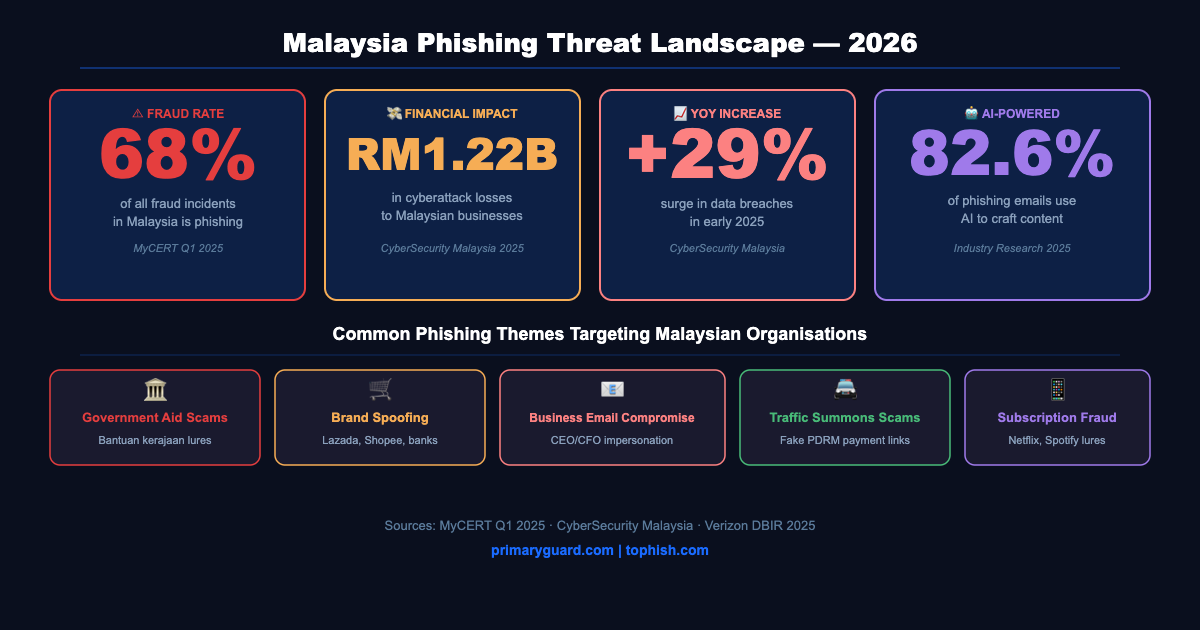
According to CyberSecurity Malaysia's Cyber999 Incident Response Centre, phishing represented 68% of all fraud incidents reported in Q1 2025. By Q4 2025, fraud continued to dominate Malaysia's cyber threat landscape. Globally, the picture is equally stark:
- Over 1.13 million phishing attacks were recorded worldwide in Q2 2025
- 82.6% of detected phishing emails used AI to craft more convincing content
- The average cost of a phishing-related breach reached USD 4.88 million in 2025
- AI-generated phishing emails have a 60% higher click-through rate than traditionally crafted ones
For Malaysian IT leaders, the threat has a distinctly local character. MyCERT data shows attackers are exploiting specifically Malaysian social contexts:
- Government aid scams impersonating bantuan kerajaan programmes
- Popular brand spoofing targeting Lazada, Shopee and major banks
- Traffic summons scams with fake PDRM payment links
- Business Email Compromise targeting finance teams via WhatsApp voice cloning
Why Technical Defences Alone Are Not Enough
Many IT teams believe they are protected because they have deployed an email gateway or spam filter. They are partially right — and dangerously wrong. Technical controls are essential, but they address only part of the attack surface. They can block known malicious domains, malware attachments, and bulk phishing campaigns. What they cannot reliably stop is:
- Spear phishing
- AI-generated zero-day content
- Business Email Compromise (where no malware or link is involved — only impersonation)
- Voice phishing (vishing) and SMS phishing (smishing) that bypass email infrastructure entirely
The Verizon 2025 Data Breach Investigations Report confirms that 60% of all breaches involve a human element. The median time between a phishing email being opened and a malicious link being clicked is just 21 seconds. Credentials are typically submitted within another 28 seconds. No SOC tool responds that fast. Only a trained employee can.
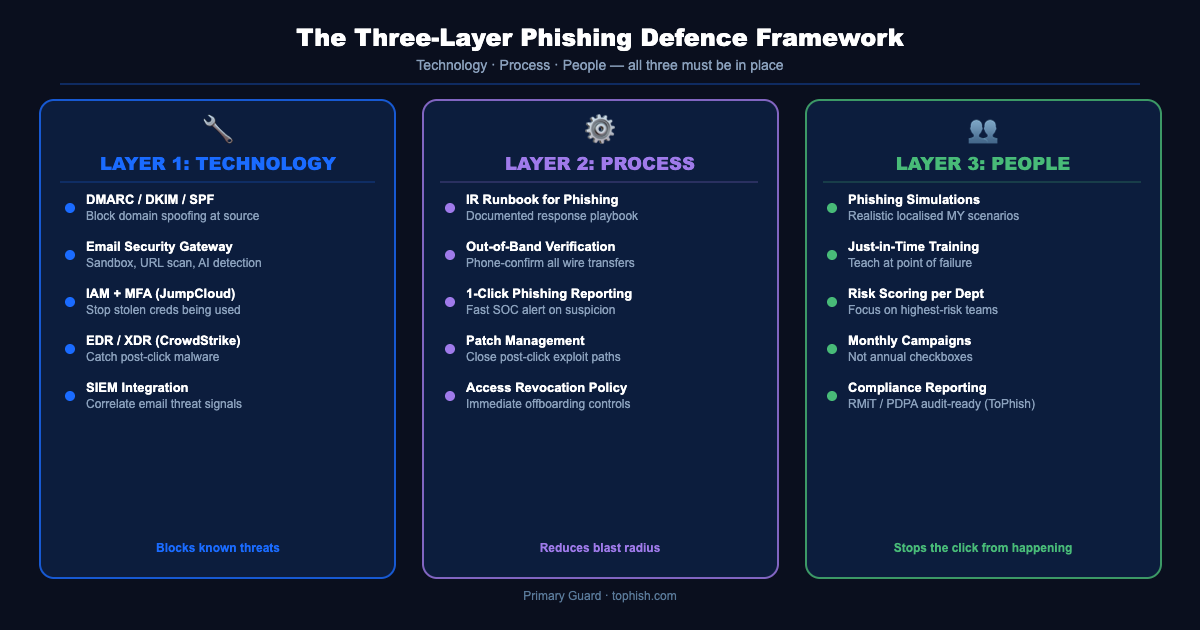
This is why phishing defence is a three-layer problem: technology, process, and people. All three must be in place.
The Complete Three-Layer Phishing Defence Framework
Layer 1: Technology — The Essential Stack
Email Authentication (DMARC, DKIM, SPF) is table stakes. Only 18.1% of global domains currently have DMARC enforcement in place — meaning over 80% remain vulnerable to direct domain spoofing. If your domain is not protected by DMARC at enforcement policy (p=reject), attackers can send emails appearing to originate from your own domain to your own staff.
Email Security Gateway adds sandboxing, URL rewriting, attachment detonation, and threat intelligence feeds. Look for solutions with real-time URL scanning at time of click, AI-based anomaly detection for BEC patterns, and integration with your SIEM or SOC platform.
Identity & Access Management (IAM) with MFA is the single highest-ROI technical control against phishing. Even if credentials are stolen, MFA blocks the attacker from using them. JumpCloud, a Primary Guard global partner, provides unified directory and IAM with ML-based anomaly detection flagging logins from unusual locations or devices before damage occurs.
Endpoint Detection & Response (EDR) with behavioural detection (not just signature-based) catches and quarantines threats that bypass email filters — including CrowdStrike, which Primary Guard deploys across Malaysia and Indonesia.
Layer 2: Process — Operational Controls
Every IT team needs a documented, tested incident response runbook for phishing: how does an employee report a suspected phishing email, who investigates, what is the SLA, and who authorises an account lockdown? Without this, even technically strong teams waste critical minutes during an active incident.
Out-of-band verification for financial requests is the primary defence against Business Email Compromise. Any request to change payment details, authorise wire transfers, or approve new supplier accounts must be verified via a separate channel — a phone call to a known number, not the number in the email. This single control would have prevented the majority of BEC losses reported in Malaysia.
Consistent patch management closes the door on the most common post-phishing exploitation paths. MyCERT Q4 2025 data flagged that malware hosting primarily targeted servers with outdated patches.
Layer 3: People — The Most Underinvested Defence
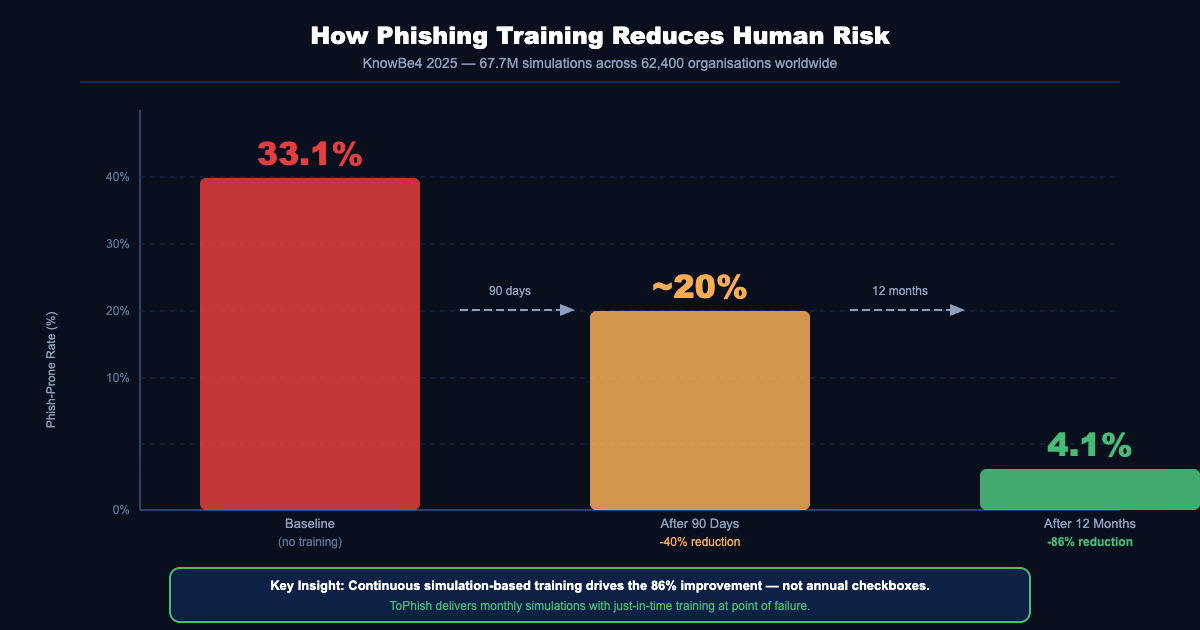
Before any security awareness training, 33.1% of employees will fail a simulated phishing test — roughly 1 in 3. At a company of 500 staff, that is 165 people who are one convincing email away from handing over their credentials. The good news: the right training works dramatically well.
Introducing ToPhish: Purpose-Built for Malaysian Organisations
ToPhish.com is a phishing simulation and security awareness training platform designed to give IT managers and system administrators the tools to measurably reduce their organisation's human risk — not just track completion rates.
- Realistic Phishing Simulations — ToPhish deploys simulated phishing campaigns that mirror the tactics, techniques, and procedures used by real threat actors targeting Malaysian organisations, including localised lures in Bahasa Malaysia, government impersonation templates, and sector-specific scenarios for finance, healthcare, and government.
- Just-in-Time Training — When an employee clicks a simulated phishing link, they receive targeted, contextual training in that moment, explaining exactly what they missed and how to identify it next time. This "teachable moment" approach is significantly more effective than scheduled training sessions conducted weeks apart.
- Workforce Risk Scoring — ToPhish provides per-employee and per-department risk scores, giving IT managers a clear, data-driven view of where human vulnerability is highest.
- Compliance-Ready Reporting — For organisations subject to Bank Negara Malaysia's RMiT guidelines or PDPA obligations, ToPhish generates audit-ready reports documenting training completion, simulation results, and risk reduction over time.
- Continuous Campaign Management — Monthly or bi-monthly rolling simulation campaigns with automated delivery, randomised templates, and progress tracking across the entire workforce.
A Practical Checklist for IT Managers
Technical Layer:
- DMARC at p=reject
- DKIM and SPF configured
- Email gateway with real-time URL scanning
- MFA enforced on all accounts
- EDR on all endpoints
- Email threat alerts integrated into SIEM
Process Layer:
- One-click phishing reporting button deployed
- Documented IR runbook
- Out-of-band verification policy for financial transactions
- Patch management cadence within 30 days
- Access revocation checklist for departing employees
People Layer:
- Baseline phishing simulation completed
- Monthly simulation campaigns scheduled
- Just-in-time remediation training enabled
- Per-department risk scores tracked quarterly
- High-privilege users on higher-frequency simulation cadence
Frequently Asked Questions
What is the most common type of phishing attack targeting Malaysian companies in 2026?
Based on MyCERT's latest quarterly reports, fraud remains the dominant threat, with phishing representing 68% of all fraud incidents. The most prevalent local vectors are government impersonation scams, popular brand spoofing (Lazada, Shopee, major banks), and WhatsApp-based Business Email Compromise targeting finance teams.
Is email filtering alone enough to protect against phishing?
No. Email filters address technically detectable threats — known malicious domains, malware attachments, and bulk campaigns. They cannot reliably stop spear phishing, AI-generated content, or Business Email Compromise attacks, which rely on impersonation rather than malware. A complete defence requires technical controls, process, and continuous staff training.
How often should phishing simulations be conducted?
Annual or one-off simulations produce minimal long-term behaviour change. Monthly or bi-monthly campaigns with immediate remediation training at point of failure produce the strongest results. KnowBe4's 2025 benchmarking data shows the 86% phish-prone rate reduction requires 12 months of continuous training.
What Malaysian regulations require cybersecurity awareness training?
Bank Negara Malaysia's Risk Management in Technology (RMiT) framework sets expectations for security awareness for financial institutions and technology service providers. The Personal Data Protection Act (PDPA) creates liability for breaches resulting from inadequate security measures.
The Bottom Line
Phishing is the leading entry point for cyber incidents in Malaysia. It is getting more sophisticated, more localised, and more effective every quarter. The organisations that will contain it are not those with the most expensive tools alone — they are those that treat phishing defence as a continuous, multi-layered programme covering technology, process, and people.
Primary Guard delivers the technical security stack. ToPhish handles the human layer. Together, they cover the full attack surface that Malaysian organisations face today.
Ready to understand your organisation's current phishing risk? Contact Primary Guard for a security posture assessment, or visit tophish.com to launch your first phishing simulation campaign.